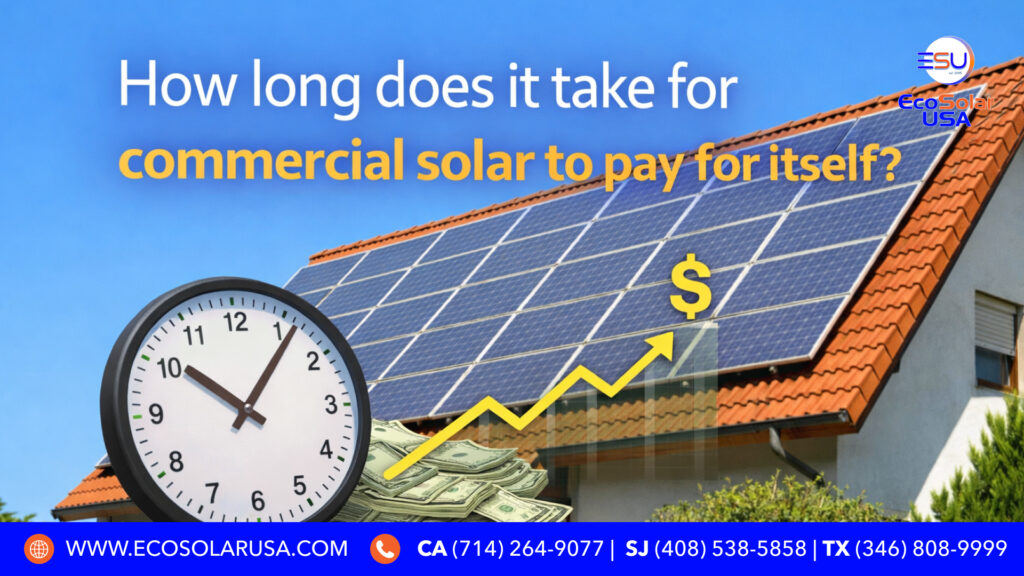
One of the most common questions business owners ask is:
“How long does it take for commercial solar to pay for itself?”
The short answer:
👉 Most commercial solar systems pay for themselves in 3 to 7 years.
However, with federal incentives at historic levels in 2026, many projects are landing closer to the 3–5 year range.
Let’s break down why.
What Is Commercial Solar Payback Period?
The payback period is the amount of time it takes for your total electricity savings to equal the net cost of installing the system.
After that point, your system continues generating power for 20–30+ years — dramatically reducing operating expenses.
For commercial property owners, this means:
- Lower utility bills
- Improved net operating income (NOI)
- Higher asset value
- Predictable long-term energy costs
Federal Incentives That Accelerate Payback
Under the Inflation Reduction Act, commercial solar projects qualify for:
- 30% Investment Tax Credit (ITC)
- +10% Domestic Content Bonus
- +10% Energy Community Bonus
- +10–20% Low-Income Community Bonus
👉 Maximum potential credit: Up to 50% of total project costs
These incentives significantly reduce upfront investment — which shortens payback time.
Commercial Solar Payback Example (2026)
Below is a realistic example for a mid-sized commercial rooftop system:
Base Scenario Breakdown
| Item | Amount | Notes |
| Total System Cost | $1,000,000 | 500kW–750kW commercial rooftop example |
| Federal ITC (30%) | -$300,000 | Base credit |
| Domestic Content Bonus (+10%) | -$100,000 | If qualified |
| Energy Community Bonus (+10%) | -$100,000 | If location qualifies |
| Low-Income Community Bonus (+10–20%) | -$100,000–$200,000 | Requires application |
| Net Effective Cost | $500,000–$700,000 | After incentives |
| Estimated Annual Utility Savings | $150,000 | High commercial usage |
| Estimated Payback Period | 3–5 Years | Depending on bonuses |
| System Lifespan | 25–30 Years | Long-term asset |
| Post-Payback Savings | $2M+ | Over system lifetime |
Payback Comparison by Incentive Level
| Scenario | Incentives Used | Net Cost | Annual Savings | Payback |
| Base ITC Only | 30% | $700,000 | $150,000 | ~4.6 Years |
| ITC + 1 Bonus | 40% | $600,000 | $150,000 | ~4 Years |
| ITC + 2 Bonuses | 50% | $500,000 | $150,000 | ~3.3 Years |
As you can see, stacking incentives dramatically accelerates ROI.
What Impacts Commercial Solar Payback?
1️⃣ Electricity Rates
Higher utility rates = faster payback.
Markets with strong solar economics typically see quicker returns.
2️⃣ Daytime Energy Usage
Warehouses, manufacturing facilities, refrigeration, and agricultural operations consume significant daytime electricity — increasing on-site solar offset.
3️⃣ Financing Structure
- Cash purchase → Fastest payback
- Loan → Slightly extended timeline
- PPA → Immediate savings, minimal upfront cost
4️⃣ FEOC Compliance
Beginning in 2026, Foreign Entity of Concern (FEOC) rules affect equipment sourcing.
Using compliant equipment ensures federal tax credits are protected.
What Happens After Payback?
Once your system pays for itself:
- Electricity generation is essentially free
- Utility inflation no longer impacts your operating budget
- Property value increases
- You benefit from 20+ years of reduced energy costs
For many commercial properties, solar becomes a long-term revenue protection asset.
Industries with the Fastest ROI
Commercial solar often pays back fastest for:
- Warehouses & logistics centers
- Cold storage facilities
- Manufacturing plants
- Agricultural operations
- Retail shopping centers
- Multi-tenant commercial buildings
Large rooftops combined with high daytime consumption create strong returns.
Is Commercial Solar Worth It in 2026?
With:
- 30% federal ITC
- Stackable bonus credits up to 50%
- Rising electricity rates
- 25–30 year system lifespan
2026 remains one of the most financially attractive periods for commercial solar adoption.
For many businesses, the question is no longer if solar pays for itself — but how quickly.
Get a Custom Payback Analysis for Your Building
If you’re operating in California or Texas, our team can help you:
- Calculate stacked federal tax credits
- Review bonus eligibility
- Verify FEOC-compliant equipment
- Compare cash vs. financing
- Estimate accurate ROI timelines
📍 Contact Ecosolar USA
ORANGE COUNTY Office
13902 Harbor Blvd., Unit 2A
Garden Grove, CA 92843
📞 (714) 265-9077
📱 (408) 538-5858
📧 info@ecosolarusa.com
Google Map: https://maps.app.goo.gl/mjZtaWrQQEX1Rcyo8
TEXAS Office
11602 Bellaire Blvd
Houston, TX 77072
📞 (346) 808-9999
📧 Info.tx@ecosolarusa.com
Google Map: https://maps.app.goo.gl/BeZU8FqzUy9pdQq49