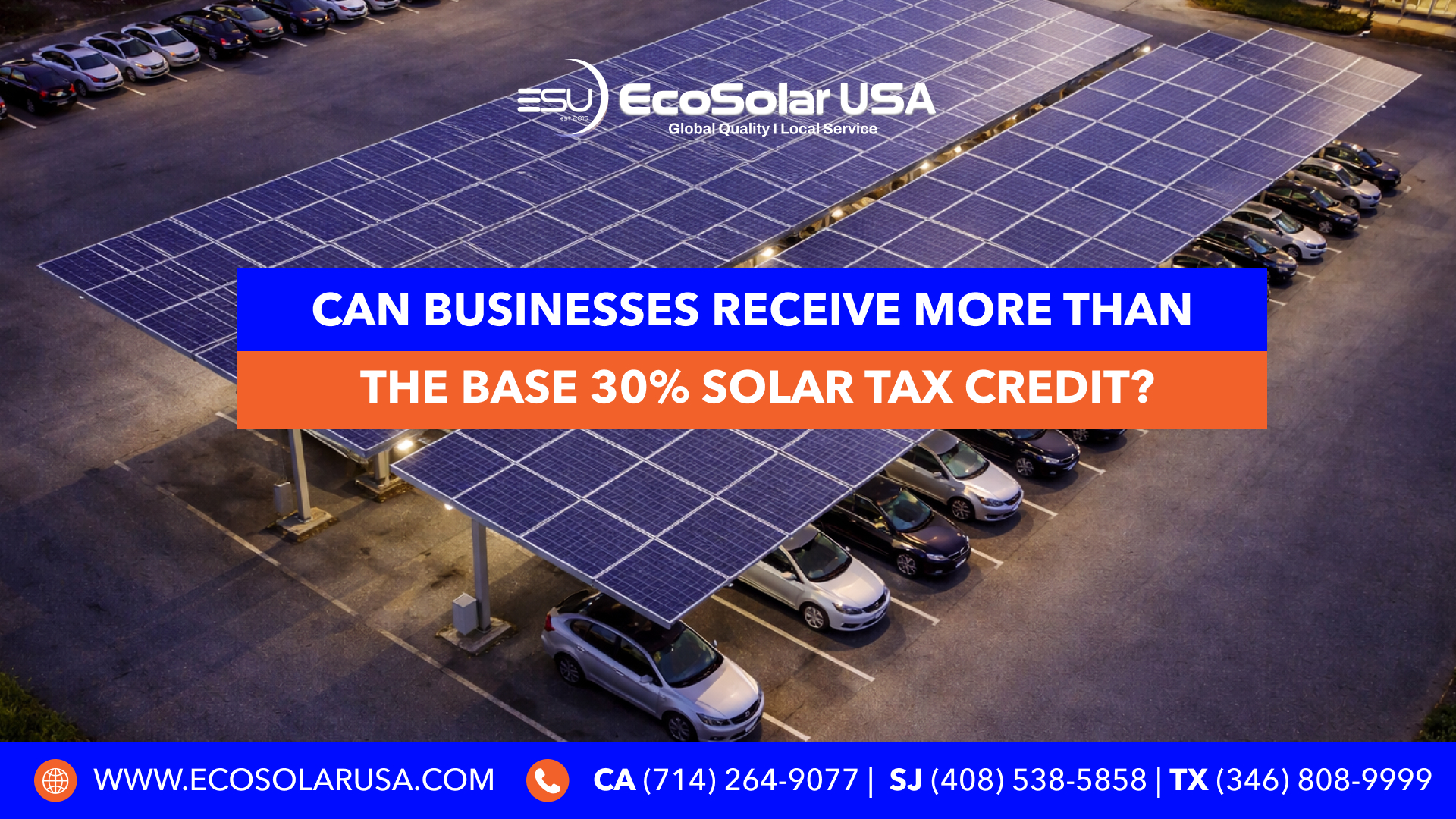
The Federal Solar Tax Credit remains one of the most powerful financial incentives for businesses investing in renewable energy. But in 2026, new compliance rules, sourcing requirements, and construction deadlines make understanding the program more important than ever.
If you’re planning a commercial solar installation, here’s exactly how the Federal Solar Tax Credit works in 2026 — and how to maximize your savings.
What Is the Federal Solar Tax Credit?
The Federal Solar Tax Credit, also known as the Investment Tax Credit (ITC), allows eligible property owners to deduct a percentage of their solar installation costs from their federal taxes.
The credit was expanded under the Inflation Reduction Act, which restored the base credit to 30% and introduced new bonus incentives.
For commercial solar projects placed in service in 2026, the base credit remains:
✅ 30% of total eligible project costs
What Costs Are Eligible?
In 2026, the tax credit applies to most direct project costs, including:
- Solar panels (modules)
- Inverters
- Racking and mounting equipment
- Electrical components and wiring
- Labor and installation
- Engineering and permitting
- Energy storage systems (battery storage)
This means the credit applies to the entire installed system cost, not just the equipment.
Who Qualifies in 2026?
The federal solar tax credit is available to:
- Commercial building owners
- Industrial facilities
- Agricultural operations
- Nonprofits (via direct pay)
- Municipalities and public entities
- Schools and universities
For residential homeowners, eligibility may differ depending on federal updates and phase-out schedules.
How the 30% Credit Is Calculated
Let’s say your commercial solar installation costs:
$500,000 total installed cost
Your federal tax credit would be:
30% × $500,000 = $150,000
This amount is applied as a credit against federal income taxes owed.
If your tax liability is lower than the credit, unused portions can typically be carried forward to future tax years.
Bonus Credits Available in 2026
In addition to the base 30% ITC, eligible projects can stack bonus credits.
Under the Inflation Reduction Act, projects may qualify for:
Domestic Content Bonus (+10%)
For systems using qualifying U.S.-manufactured components.
Energy Community Bonus (+10%)
For projects located in fossil-fuel-dependent communities or brownfield sites.
Low-Income Community Bonus (+10–20%)
Available through a federal application process for qualifying projects.
Maximum Potential Credit
Projects that qualify for stacked bonuses may receive:
👉 Up to 50% of total project costs
New 2026 Compliance Requirements
While the 30% credit remains available, 2026 introduces stricter compliance rules.
1. Prevailing Wage & Apprenticeship Requirements
Projects above certain size thresholds must meet federal labor standards to receive the full 30% credit.
Failure to comply may reduce the credit significantly.
2. Foreign Entity of Concern (FEOC) Rules
Starting in 2026, projects must meet supply chain sourcing requirements.
If too many components are sourced from restricted foreign entities, the project could lose eligibility for the tax credit.
Proper equipment selection and documentation are essential.
3. Construction Deadlines
Projects must meet federal “begin construction” and placed-in-service deadlines to preserve eligibility and bonus credits.
Direct Pay & Credit Transfer Options
The Inflation Reduction Act introduced two major enhancements:
Direct Pay
Tax-exempt entities (nonprofits, schools, municipalities) can receive the credit as a direct payment instead of a tax offset.
Transferability
Businesses can transfer (sell) tax credits to other taxpayers in certain situations.
These provisions expand access to solar incentives for a wider range of organizations.
Why Acting Before 2026 Deadlines Matters
Even though the credit remains available in 2026, future policy changes could:
- Reduce the base percentage
- Tighten eligibility requirements
- Eliminate bonus adders
- Increase compliance complexity
Commercial property owners who act early can:
- Lock in current incentive levels
- Secure compliant equipment
- Avoid supply chain delays
- Maximize long-term ROI
How to Maximize Your Solar Tax Credit in 2026
To fully benefit from the Federal Solar Tax Credit:
- Conduct a professional feasibility assessment
- Confirm eligibility for bonus credits
- Review FEOC compliance requirements
- Meet labor and wage standards
- Begin construction before key deadlines
- Maintain thorough documentation
Working with an experienced commercial solar installer ensures compliance and maximized savings.
📞 Get Expert Help with Your 2026 Solar Project
If you’re planning a commercial solar installation in California or Texas, our team can help you:
- Calculate your exact tax credit savings
- Evaluate bonus eligibility
- Ensure FEOC compliance
- Design and install a fully compliant solar system
🇺🇸 Orange County Office
📍 13902 Harbor Blvd., Unit 2A
Garden Grove, CA 92843
📞 (714) 265-9077
📱 (408) 538-5858
📧 [email protected]
Location: 13902 Harbor Blvd Unit 2A
🤠 Texas Office
📍 11602 Bellaire Blvd
Houston, TX 77072
📞 (346) 808-9999
📧 [email protected]
Location: 11602 Bellaire Blvd